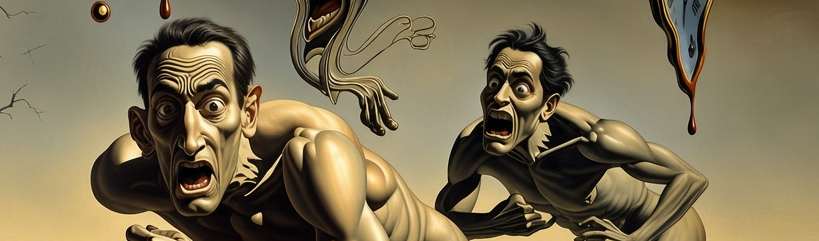
The “Rousseau-Kropotkin paradigm” sees humans as a naturally benign and unaggressive species corrupted by society, while the “Hobbs-Huxley” paradigm sees humans as a naturally aggressive species civilised by society. Which is correct?
Psychology has made some interesting contributions to this age-old question of the innate and/or environmental origins of human aggression. Sigmund Freud (1856-1939), whose work was deeply influenced by Darwin, elaborated the concept of a drive as an energy which originates within the organism. He proposed that human behaviour is fuelled by two primary forces or drives: Eros the life drive; and Thanatos the death drive. Aggression is the outward manifestation of Thanatos, an innate unconscious urge pushing humans towards destruction and decay. For Freud aggression is innate, universal and negative.
Melanie Klein placed Freud’s concept of Thanatos at the core of her object relations theory, arguing that an innate struggle between the life instinct (Eros) and the death instinct (Thanatos) shapes infant development. She believed that infants are born with an internal awareness of Thanatos which is experienced primarily as a fear of being destroyed or annihilated from within.
In the twentieth century new perspectives were developed, with key contributions from a trio of British psychoanalysts. John Bowlby (1907-1990), creator of attachment theory, did not view aggression as an innate, primary drive or instinct; instead, it is a reactive adaptive response triggered when an infant or child’s core behavioural systems are frustrated or threatened. Donold Winnicott (1896-1971), paediatrician, had a positive view of aggression as a vital expression of life force and a creative tool for discovering reality. For Wilfred Bion (1897-1979) the role of the mind is crucial in whether aggression develops. He believed that the mind is constructed for one ultimate purpose: to prevent the psyche being destroyed by its own unmediated emotions.
A bimodal view of aggression may help to answer the Rousseau/Hobbs question.
If anger underlies reactive aggression, then where do emotions come from? Are there universal expressions of emotion that are transmitted genetically as Darwin, Plutchik and Ekman would argue? Lisa Feldman Barrett’s theory of constructed emotions is the brain builds emotions in the moment, using past experiences, internal bodily sensations and cultural concepts.
I will explore what these themes suggest about human aggression.